Chapel of St. Kinga in Wieliczka - History and Highlights
The Chapel of St. Kinga in the Wieliczka Salt Mine lies 101 m underground. We cover its history, the miners who carved it, its salt reliefs and the ring legend.
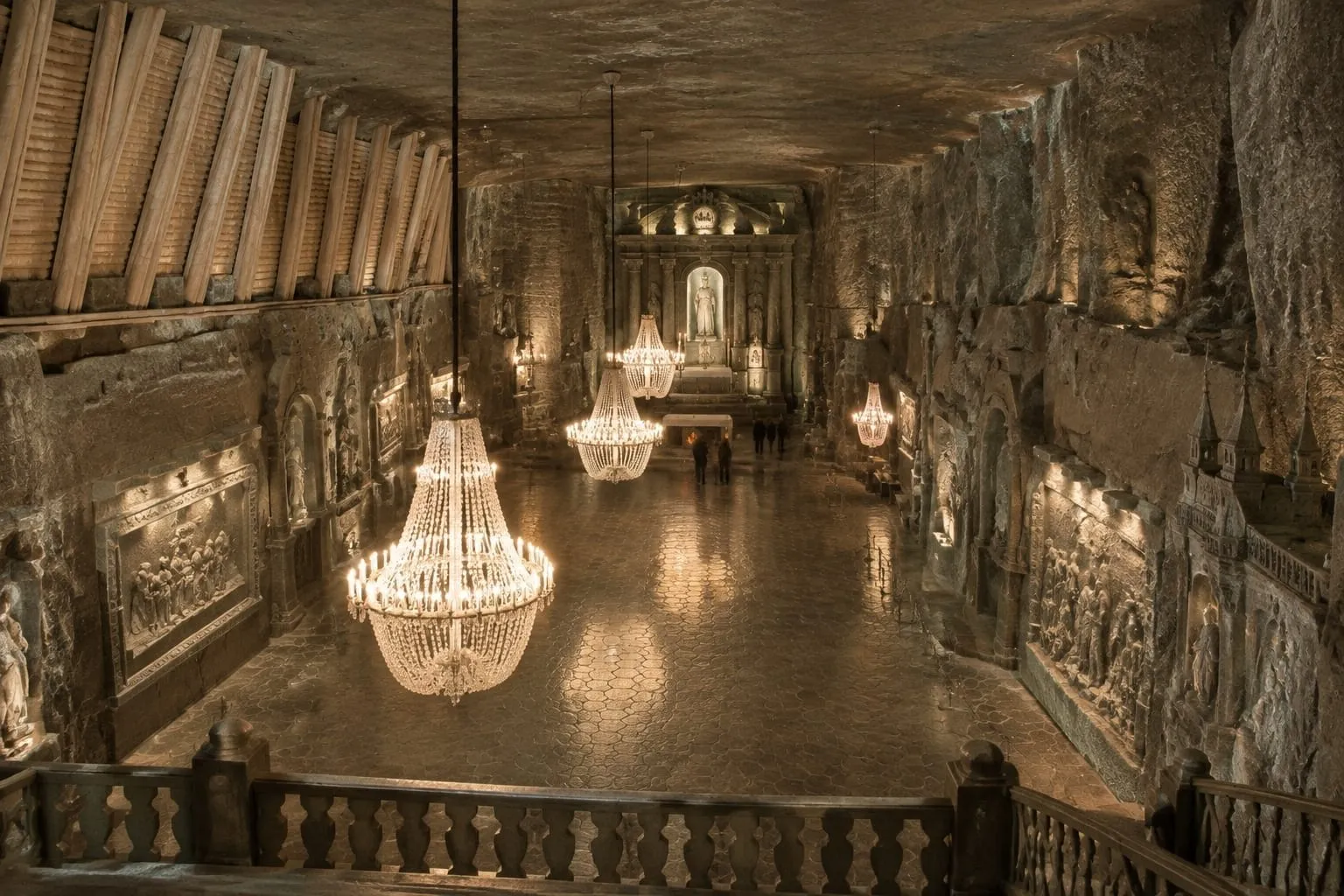
The Chapel of St. Kinga is the place where visitors on the Tourist Route in Wieliczka slow down and fall silent. After an hour of walking through narrow passages, an interior 54 metres long suddenly opens up, with chandeliers, an altar and a floor all carved out of salt. All of this lies 101 metres below the surface, and yet the chapel still works as a church - masses, Christmas midnight masses and weddings are held here.
Most tourists spend ten to fifteen minutes in the chapel and leave with a general impression that it was beautiful. That is a pity, because every element of this interior has its own story and its own author. Behind the altar is a particular miner who carved salt after his shift. Behind the relief of “The Last Supper” is another miner, who took Leonardo da Vinci as his model. And behind the whole chapel is the legend of a Hungarian princess and a ring thrown into a mine shaft.
In this article we describe the chapel the way it deserves to be seen - element by element. We explain who created it and when, what the reliefs show, where the legend of St. Kinga comes from and what religious life underground looks like. At the end we add practical tips so that your time in the chapel does not end with a single photo taken in a hurry. Our argument is simple - the Chapel of St. Kinga is the best-documented work of folk art in the entire mine, and it is worth knowing its story before you step onto the balcony above the nave.
Chapels in the salt mine
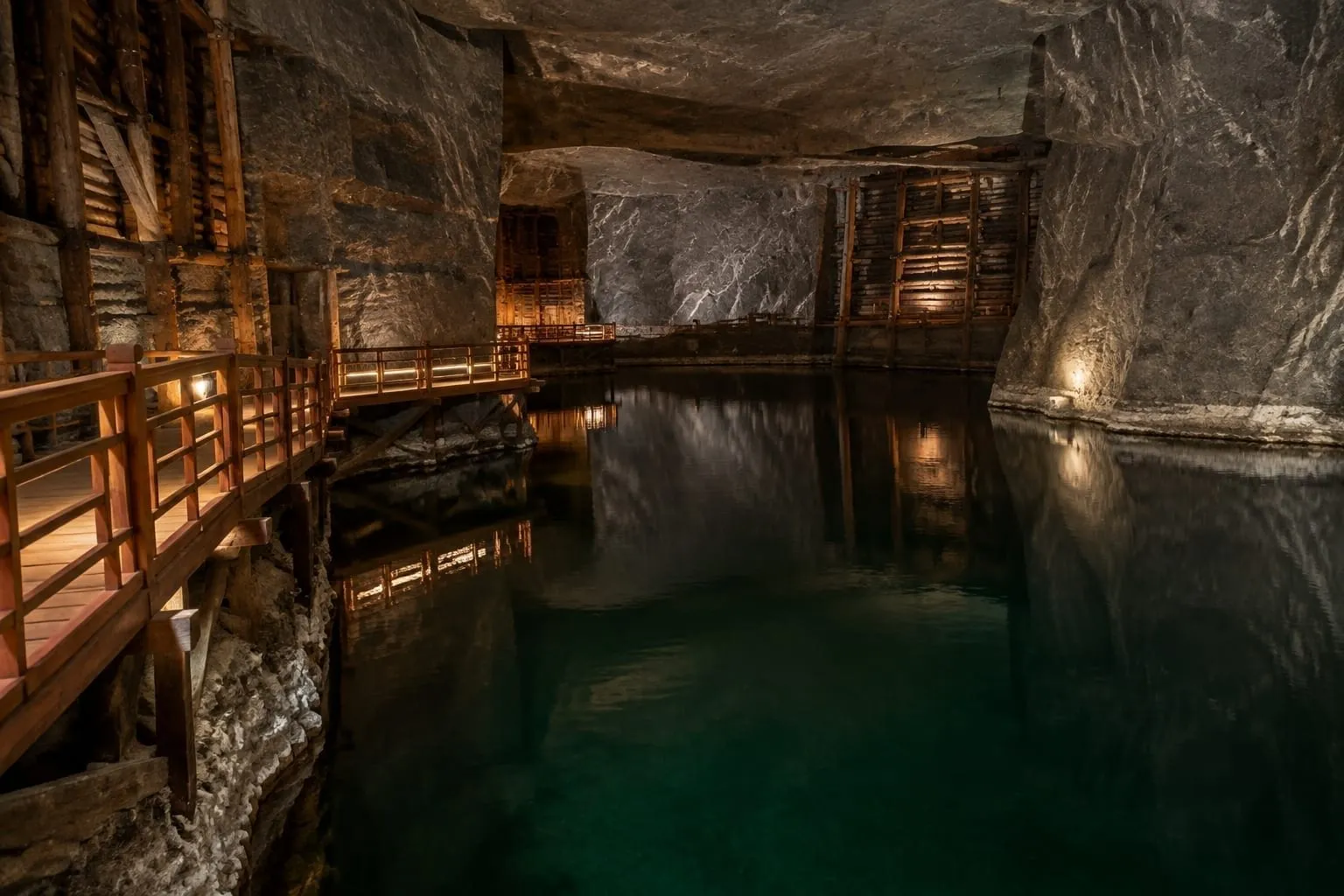
The Wieliczka Salt Mine (Kopalnia Soli “Wieliczka”) has been in operation since the mid-13th century, and in 1978 it was included on the very first UNESCO World Heritage List. Over the centuries miners carved chapels into it, because work underground was dangerous and prayer before going down and after coming up was part of daily life. The Chapel of St. Kinga (Kaplica św. Kingi) is the youngest and largest of them. You pass smaller chapels on the Tourist Route (Trasa Turystyczna) as well, but it is in this chamber that guides keep groups the longest, and photos from the balcony above the nave are the most widely published image of the whole mine.
According to the Kraków Saltworks Museum (Muzeum Żup Krakowskich Wieliczka), the chamber was created in 1896 on the site of a huge, fully mined block of green salt. The miners first extracted the salt and then began to fit out a place of worship in the empty space left behind. The museum gives its dimensions as roughly 12 metres high, 18 metres wide and 54 metres long. Work on the decoration took almost 70 years, and the last sculptures were made at the turn of the 20th and 21st centuries.
A few terms make the visit easier. A chamber is the space left after a block of salt has been extracted. Green salt is a variety of rock salt with a greyish-green tint, mined in Wieliczka. Halite is the mineral name for rock salt - you can see its crystals behind the figure of St. Kinga in the altar. The presbytery is the part of a church around the altar, separated from the nave.
It also matters who the creators were. The chapel was not designed by professional, academy-trained artists. The decoration was made by self-taught miners - Józef and Tomasz Markowski and Antoni Wyrodek - who knew salt as the material of their work rather than as a sculptor’s medium. You can see this in the details: the proportions of the figures are sometimes simplified, but the salt itself is worked with great precision.
The chapel therefore combines three things. It is a place of worship, a post-mining space that shows the scale of historical extraction, and a gallery of folk art created over several generations. That is why telling its story requires both religious and mining history.
In travel guides the chapel usually gets a single paragraph. What is missing is a description that would let you recognise specific reliefs on the spot and understand why it is St. Kinga who stands in the altar. This article aims to fill that gap.
What you see on entering the Chapel of St. Kinga
Visitors usually come out onto a balcony in the upper part of the chapel and then walk down a staircase to the level of the nave. The balcony gives the best view of the full length of the interior and the row of chandeliers. According to the Kraków Saltworks Museum, the chandeliers are made of salt crystals and the floor was carved from a single solid block of salt. The pattern on the floor looks like stone tiles, but it is part of the same salt mass.
The main altar
At the far end of the nave stands a three-part altar made by Józef Markowski. Originally its centre held an oil painting by Ferdynand Olesiński showing St. Kinga and a miner handing her a ring. In 1914 the painting was replaced by a salt figure of St. Kinga, also carved by Markowski. Behind the figure you can see halite crystals, and the side sections of the altar hold sculptures of St. Joseph and St. Clement, patron of miners and of the Wieliczka parish.
The pulpit and side altars
Józef Markowski also made the pulpit. Its base depicts Wawel Hill with the dragon, which links the chapel with the history of Kraków. It is a good example of the miners’ sense of humour and local pride, as they placed one of Kraków’s best-known legends in a religious interior. On either side are two side altars - of the Sacred Heart of Jesus and the Immaculate Heart of Mary. In the presbytery stands a papal cross which, according to the museum, symbolises Poland’s four salt mines: Wieliczka, Bochnia, Kłodawa and Sieroszowice.
The monument to John Paul II
The most recent major element is the salt monument to John Paul II. The decision to create it was taken in 1999 as a gesture of thanks for the canonisation of St. Kinga. The design was prepared by Prof. Czesław Dźwigaj, and the sculpture was made by Stanisław Anioł, Paweł Janowski and Piotr Starowicz. The same team, led by Stanisław Anioł, made a new salt altar table in 2002-2003, which replaced the earlier wooden one.
The miner-sculptors and their craft
The most fascinating thing about the chapel is who created it. Józef and Tomasz Markowski and Antoni Wyrodek worked in the mine as miners. They carved in salt, a material they knew from their daily work, and they did so for decades. The museum notes that Tomasz Markowski worked on the decoration between 1920 and 1927.
The work was divided roughly as follows. Józef Markowski created the main altar, the figure of St. Kinga, the pulpit, the side altars and the first figures in the nativity scene. Tomasz Markowski made the reliefs “Doubting Thomas” and “The Massacre of the Innocents”, three figures of Mary in the Chapel of the Resurrection and a small relief of St. Kinga with a miner. Antoni Wyrodek is the author of “The Last Supper”. According to sources on the chapel’s history, Józef Markowski set up the first nativity figures in 1903 on a rock ledge by the north wall of the church, and further figures were added in the years that followed. After the Second World War, Mieczysław Kluzek made a salt nativity scene that replaced the earlier figures.
Carving salt requires a different technique from carving stone. Salt is soft and easy to work, but at the same time it dissolves in water and absorbs moisture from the air. That is why the reliefs in the chapel are mostly shallow, without thin, projecting parts. Close-up photos reveal chisel marks and variations in the colour of the salt, from grey to almost transparent.
The strength of this art is its authenticity. It is the work of people who knew every layer of the deposit. Its weaker side is the simplified anatomy and perspective, which art specialists will notice straight away. For visitors, however, this hardly matters, because the chapel impresses through its scale and the consistency of the whole design.
Reliefs from the New Testament
The walls of the chapel are decorated with reliefs depicting biblical scenes. It is worth looking at them in order, as together they tell the story of the life of Jesus. The Kraków Saltworks Museum lists among them the Wedding at Cana, the Flight into Egypt, Christ Teaching in the Temple, the Road to Bethlehem, Doubting Thomas, the Massacre of the Innocents and Herod’s Judgement.
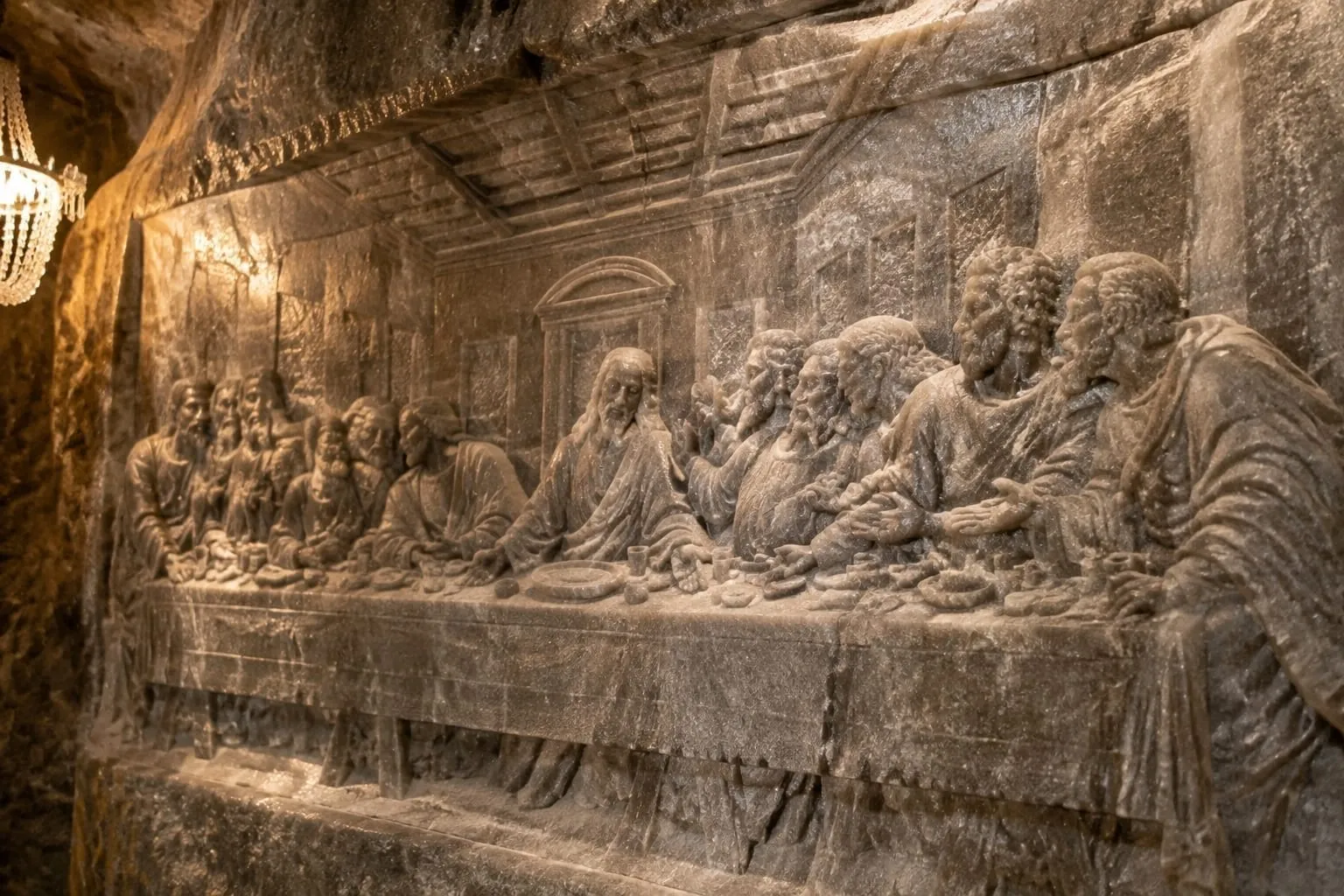
The most photographed of them is Antoni Wyrodek’s “The Last Supper”. The composition draws on Leonardo da Vinci’s fresco, but the depth of the room in which the apostles sit is rendered in shallow relief. It is worth stepping closer and looking at it from the side - then you can see how shallow the relief is and how cleverly the illusion of space has been created.
To the left of the main altar is the relief “The Miracle at Cana”, a good starting point for viewing the series. The scenes are not arranged in strict chronological order, so it helps to recognise them by their characteristic motifs. The Flight into Egypt is easy to spot thanks to the donkey, Christ Teaching in the Temple by the twelve-year-old boy surrounded by scholars, and Doubting Thomas by the apostle touching the wounds of Jesus. With each scene, pay attention to the background - the miners often added architecture and landscape, which in salt demanded exceptionally patient work.
| Element | Author | Notes |
|---|---|---|
| Main altar and figure of St. Kinga | Józef Markowski | the 1914 figure replaced a painting |
| Pulpit with Wawel Hill | Józef Markowski | base featuring the Wawel dragon |
| The Last Supper | Antoni Wyrodek | modelled on Leonardo da Vinci’s work |
| Doubting Thomas, The Massacre of the Innocents | Tomasz Markowski | reliefs on the side walls |
| Nativity scene | Mieczysław Kluzek | salt figures made after the Second World War |
| Monument to John Paul II | designed by Czesław Dźwigaj | made by S. Anioł, P. Janowski, P. Starowicz |
| Altar table | Stanisław Anioł and team | 2002-2003 |
The legend of St. Kinga’s ring
Why is the chapel named after St. Kinga? Kinga was a Hungarian princess and the wife of Bolesław the Chaste, Duke of Kraków. She died in 1292, and John Paul II canonised her on 16 June 1999 in Stary Sącz. Her feast day falls on 24 July. She is the patron saint of salt miners, and legend links her directly with Wieliczka.
According to the tale, before leaving Hungary Kinga did not want a dowry in gold and instead asked her father for salt. Her father gave her a salt mine in Máramaros. Kinga threw her engagement ring into the shaft, and after arriving in Poland she pointed out the place where people should dig. There the miners struck a block of salt, and inside it they found the princess’s ring. And that, according to legend, is how the history of Poland’s salt mines began.
Historians treat this story as a legend. Salt was being boiled from brine around Wieliczka long before Kinga was born, and rock salt mining developed here in the mid-13th century. Even so, the legend captures well how important salt was to the economy of medieval Poland and how strongly it was associated with the figure of the duchess.
Since 1994 relics of St. Kinga have rested in a niche in the chapel’s altar table. The ring scene is shown in the small relief by Tomasz Markowski mentioned above. It is worth looking for, as it is easy to miss next to the large biblical scenes.
A working church underground
The Chapel of St. Kinga is not just an exhibit. The Kraków Saltworks Museum states that Sunday masses, weddings and an underground Christmas midnight mass (pasterka) are held here. Masses are also celebrated on the feast days of the miners’ patron saints - St. Kinga (24 July) and St. Barbara (4 December).
The midnight mass in the mine has a long tradition. On Christmas night miners and their families go down to the chapel, and every year the Kraków media publish broadcasts and reports of this mass. For many residents of Wieliczka it is a fixed part of Christmas, and for visitors a chance to see the chapel in a role other than a tourist attraction. Weddings are similar - the couple and their guests go underground, and the ceremony takes place in the same spot that groups of visitors pass during the day.
The chapel has excellent acoustics, which is why intimate classical music concerts are held here from time to time. Performers have included Nigel Kennedy and the band Blackmore’s Night. Event dates and the rules for attending mass are announced by the mine and the parish, so if you are coming for a specific reason, it is worth checking them first.
How to see the Chapel of St. Kinga
The Chapel of St. Kinga lies on the Tourist Route. According to the mine’s official website, the route is 3.5 km long, the visit takes an average of 2-3 hours including the Kraków Saltworks Museum exhibition, and there are more than 800 steps to cover. The route reaches a depth of 135 metres, and the temperature underground is 17-18°C. The mine welcomes visitors from 8:00 to 18:00, and the current ticket prices are listed on wieliczka-saltmine.com. For organised groups there is also the Pilgrimage Route, on which the chapel is the main highlight.
A few tips that help you see the chapel better:
- Pause a little longer on the balcony. It is the only spot from which you can see the full length of the interior and the row of chandeliers.
- View the reliefs in order, starting from the altar end. It is handy to have the table from this article saved on your phone.
- Do not touch the salt. Moisture and grease from hands damage the surface of the reliefs.
- Take photos without flash - salt crystals reflect the light, and flash photos come out flat.
- Guided groups have limited time in the chapel, so it is best to ask about particular sculptures straight away.
The tour starts at the Daniłowicz Shaft (Szyb Daniłowicza), so if you are coming by car, it pays to plan your arrival in advance. We recommend the Salt Mine car park with online booking, about 30 metres from the Daniłowicz Shaft. A ticket with a QR code arrives by email, and your space is guaranteed for the chosen day. With a route lasting up to three hours and a meal afterwards, a full-day ticket is the more practical choice. Entry to the car park is possible from 7:00 to 18:00, and you can leave at any time of day or night.
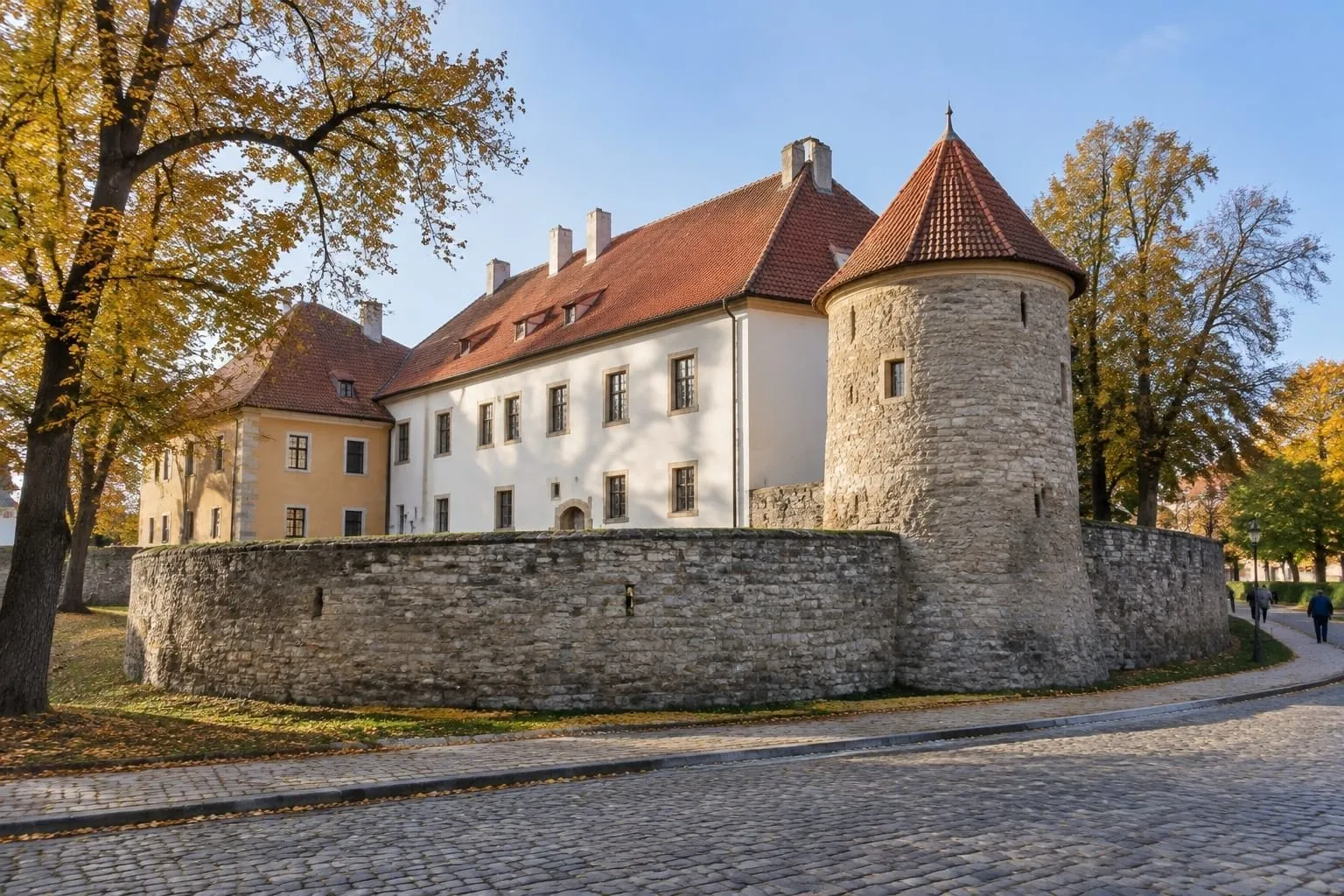
After leaving the mine, it is worth staying on in town. The Saltworks Castle (Zamek Żupny) is about a 4-minute walk from the car park, and we cover its history in the article Saltworks Castle in Wieliczka - visiting and history.
A chapel that is still changing
The Chapel of St. Kinga is not a finished work. Its history shows that the decoration has been added to for more than a hundred years - from Markowski’s altar, through Kluzek’s nativity scene, to the papal monument and the new altar table of 2002-2003. One can expect future generations of salt sculptors to add new elements, while conservators look after the oldest ones. The tradition of salt carving in Wieliczka still has its continuators, as shown by the team that made the papal monument and the altar table. Any such change, however, will require conservation approval, because the mine is a UNESCO-listed monument.
Protecting the salt from moisture is an ongoing task for the mine. With large numbers of visitors, every breath changes the microclimate of the chamber, which is why the mine’s ventilation matters as much to the chapel as the chisel did to its creators.
The way people visit is changing too. The Kraków Saltworks Museum offers a virtual tour of the chapel, which lets you see the interior before you arrive or go back to the details after your visit. Tools like this help visitors who want to know what they are looking at to prepare for the tour. They are also useful for people who cannot walk the whole route because of the stairs.
The chapel is also growing in importance as an events venue. Weddings, concerts and masses attract people who come to Wieliczka for a specific purpose rather than for the standard route. This trend strengthens the chapel’s role as a living church rather than just a museum chamber.
The Chapel of St. Kinga in brief
The Chapel of St. Kinga was created in 1896 in a chamber left by an extracted block of green salt, 101 metres underground. It is 54 metres long, 18 metres wide and about 12 metres high. Its decoration was created over almost 70 years, and the last elements were added at the beginning of the 21st century.
Its most important creators were self-taught miners - Józef and Tomasz Markowski and Antoni Wyrodek. Józef Markowski made the main altar with the salt figure of St. Kinga and the pulpit with the Wawel dragon. Antoni Wyrodek carved “The Last Supper”, modelled on Leonardo da Vinci. The monument to John Paul II and the new altar table are the work of Stanisław Anioł’s team.
The chapel’s patron, St. Kinga, is linked with Wieliczka through the legend of the ring found in a block of salt. Her relics have rested in the altar since 1994, and since her canonisation in 1999 the chapel has been an important place of her veneration.
To return to the argument from the introduction - the chapel is worth seeing with an awareness of who created each element and when. Then ten or fifteen minutes on the Tourist Route become a lesson in history and folk art. Before your visit, we recommend checking the opening hours on the mine’s website and booking a parking space in Wieliczka for your chosen day, and after the tour, stopping at one of the places described in our guide to where to eat in Wieliczka near the mine.
Questions about the Chapel of St. Kinga
How deep underground is the Chapel of St. Kinga?
The chapel lies 101 metres underground. The Tourist Route as a whole reaches a depth of 135 metres, so the chapel sits roughly in the middle section of the route.
Is everything in the chapel made of salt?
Most of the decoration is - the floor, the altar, the figures, the reliefs and the chandeliers made of salt crystals. According to the museum, the altar once held an oil painting and the altar table was wooden. Both were replaced with salt elements. The figure of St. Kinga appeared in the altar in 1914, and the salt altar table in 2002-2003.
Can you get married in the Chapel of St. Kinga?
Yes, the Kraków Saltworks Museum states that weddings are held in the chapel. Details and dates have to be arranged directly with the mine and the parish. It is worth doing this well in advance, as the number of dates is limited and the organisation also involves taking the guests underground.
Are masses held in the chapel for worshippers who are not on a tour?
According to the museum, Sunday masses are celebrated in the chapel, as well as masses on the feast days of St. Kinga and St. Barbara. It is worth checking the entry rules and times before you travel, as they may change. The most reliable sources are the official website of the mine and the Parish of St. Clement in Wieliczka.
How much time do you spend in the chapel during a tour?
On the Tourist Route, groups usually stop in the chapel for ten to fifteen minutes. Anyone who wants to study the reliefs in detail can go back to them through the virtual tour prepared by the museum. For organised groups there is also the Pilgrimage Route, on which the chapel is the main point of the programme.
Can you take photos in the chapel?
Visitors do photograph the chapel, including from the balcony above the nave. The current photography rules are set out in the visitor regulations on the mine’s website. Shooting without flash gives better results. The most striking shots are taken from the balcony, where you can see the row of chandeliers and the whole nave.
Where should you park to reach the mine quickly?
The closest option to the Tourist Route entrance is the car park 30 m from the Daniłowicz Shaft, with online booking and 24/7 CCTV.
Who carved the Chapel of St. Kinga?
The main decoration was made by self-taught miners - Józef and Tomasz Markowski and Antoni Wyrodek. Józef Markowski made the main altar and the pulpit, Antoni Wyrodek carved “The Last Supper”, and Tomasz Markowski carved works including “Doubting Thomas”. The nativity scene was made after the Second World War by Mieczysław Kluzek, and the monument to John Paul II by Stanisław Anioł’s team to a design by Prof. Czesław Dźwigaj.